Broker Check

Our Philosophy

At Townsend Financial Life Management our investment philosophy revolves around a personalized, planning-based approach tailored to our clients' goals and financial profiles. We believe in a disciplined investment process that helps us identify portfolios that are diversified and aligned with client’s individual risk tolerances and retirement plans. Regular monitoring and proactive rebalancing help us adapt to market changes, aiming to protect portfolios and optimize returns.


Importantly, we are committed to offering unbiased advice, free from the constraints of proprietary products, and leverage tax-efficient strategies like ETFs and tax loss harvesting to help enhance portfolio performance.


Our ongoing support includes annual reviews and direct access so we can provide comprehensive guidance, ensuring our clients' investment strategies evolve with their needs and market dynamics.

Strategic Allocation Portfolios

Strategic Portfolios

Strategic Portfolios

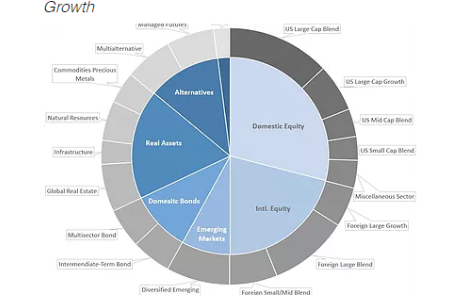
Our portfolios begin with creating strategic asset allocations for the Growth and Income Portfolios. The strategic allocations for each portfolio have different risk/return profiles. All portfolios are well diversified and designed to meet different investment objectives.


Strategic Asset Allocation can be thought of as the baseline long-term asset allocation for each portfolio. 

Asset Allocation Process

Asset Allocation Process

The first step in our Asset Allocation Process is to establish a strategic (long-term) asset allocation for each portfolio. We believe that at the core of building a diversified and efficient portfolio is Modern Portfolio Theory (MPT).

According to the MPT, it's possible to construct an "efficient frontier" of optimal portfolios. We utilize the expected return, correlations, and standard deviation of various asset classes to design the most efficient growth and income portfolio.
Building Blocks

Building Blocks

The first step is to determine the type of asset classes and investments to use in constructing the portfolio. Below is a list of some asset classes.

These broad asset classes can be further broken down into sub asset classes that can be used to create a more efficient portfolio. For example, international stocks would include developed markets and emerging market equities as well as growth and value components.

Asset allocation and diversification do not assure or guarantee better performance and cannot eliminate the risk of investment loss. As with any investment strategy, there is the possibility of profitability as well as loss.

Retirement Wealth Strategy

Townsend Financial Life Management provides recommendations and manages client wealth based on the fundamental belief that in order to be successful meeting each client’s individual retirement goals, is through the use of a strategically designed asset allocation and diversification strategy. This includes the use of investment portfolios and insurance solutions. The key considerations used to determine the appropriate strategy are:

  • Tax allocation – Determining the optimal allocation for assets, specific to their tax status (deferred or tax-free), involves considering the following factors:
    • Current tax rate
    • Future projected tax rate
    • The advantage of tax deferred or tax free solutions
  • Investment diversification through the use of strategic portfolios based on a client's retirement plan and risk profile.
  • The strategic use of insurance solutions to protect against longevity risk (guaranteed income for life), protect against pre-mature death (life insurance), create a source of future tax free income (cash value life insurance), protect earned income (disability insurance), provide for efficient and potentially tax free transfer of wealth (life insurance, annuities), protect future generations against potential estate tax liabilities (life insurance), cost of long-term care (LTC Insurance)

Have a Question?

Thank you!
Oops!

Several factors will affect the cost and availability of life insurance, including age, health, and the type and amount of insurance purchased. Life insurance policies have expenses, including mortality and other charges. If a policy is surrendered prematurely, the policyholder also may pay surrender charges and have income tax implications. You should consider determining whether you are insurable before implementing a strategy involving life insurance. Any guarantees associated with a policy are dependent on the ability of the issuing insurance company to continue making claim payments.

A fixed annuity is for retirement or other long-term financial needs. It is intended for a person who has sufficient cash or other liquid assets for living expenses and other unexpected emergencies, such as medical expenses. A fixed annuity is not a registered security or stock market investment and does not participate in any stock or equity investment or index. Guarantees are based on the claims paying ability of the issuing company.

Asset allocation and diversification do not assure or guarantee better performance and cannot eliminate the risk of investment loss. As with any investment strategy, there is the possibility of profitability as well as loss. Past performance is not indicative of future results. Options involve risk and are not suitable for all investors. Certain complex options strategies carry additional risk. Please read the options disclosure document titles Characteristics and Risks of Standardized Options by clicking on this hyperlink text https://www.theocc.com/about/publications/character-risks.jsp before considering any options transactions. Covered calls provide downside protection only to the extent of the premium received and limit upside potential to the strike price plus premium received.